
Duke Energy's proposed large load tariff for the Carolinas starts at 50 megawatts. Few manufacturers will ever come near that number. All of them will feel what it says about how power is being planned.
Most manufacturers do not think about the electric grid until they need more of it. They know their rate, they know their bill, and they assume that when the new line goes in, the power will be there.
That assumption is getting harder to make. The reason is not manufacturing.
On October 6, 2026, Duke Energy filed a settlement with the North Carolina Utilities Commission for a new large load tariff covering its two Carolina utilities. The parties signing it include the Commission's Public Staff, Amazon, Google, Microsoft, the Department of Defense and an industrial customers' group. The tariff would apply to new service with a contract demand of 50 megawatts or more at a high, steady load factor, or 150 megawatts or more at any load factor. Contracts below 100 megawatts would run at least 10 years, and those of 100 megawatts or more at least 15. The tariff is proposed to take effect January 1, 2027, and it still needs the Commission's approval.
This is not just a data center story. It is a story about who gets power, and when.
Why a 50 Megawatt Rule Matters to a 5 Megawatt Plant
A typical midsize manufacturer will never come close to 50 megawatts. A precision machining shop, an equipment assembler or an electronics plant in the 50,000 to 150,000 square foot range needs a fraction of that. So why should a plant manager care?
Because a utility does not write a special tariff for customers it rarely sees. It writes one for customers it is planning around. The settlement exists because the largest new requests on the Carolinas grid now come from hyperscale data centers and other very large loads, and the utility wants those customers to carry the cost of the generation and transmission they require.
The scale of that planning is visible in the state's own numbers. In February 2026, Governor Stein's Energy Policy Task Force reported that Duke Energy's 2025 load forecast projects total demand across its two Carolina systems to grow 16% to nearly 60% through 2040. From 2005 to 2025, electricity demand in all of North Carolina rose just 7%.
A grid that grew 7% in twenty years is now planning for growth several times larger. When that happens, the constraint for everyone else is rarely the price of a kilowatt hour. It is the queue. Substation upgrades, new feeders and transmission studies all take time, and a manufacturer asking for a few extra megawatts is in the same line of work orders as everyone else.
Price Is One Question. Capacity Is the Other.
North Carolina still has competitive industrial power rates, and that matters. But the rate only helps a company that can get connected on its schedule.
Before a manufacturer signs a lease or buys land, there are four questions worth asking about power, and they have little to do with the rate.
How much power is at the building today, in amps or megawatts, not in a marketing brochure?
How far can it be expanded, and has the utility already studied that expansion?
Who pays for any upgrade, and how long would it take to energize?
What happens to the production schedule if the answer to the last question is "longer than expected"?
For a greenfield site, honest answers to those questions often push the start of production out by months. Permitting is already slow for new construction in North Carolina. Waiting on power on top of it turns a schedule risk into a schedule problem.
What Existing Power Buys a Manufacturer
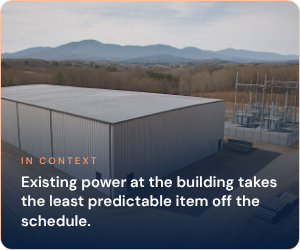
An existing industrial building with serious electrical service takes the least predictable item off the critical path. The power is already there, the utility relationship already exists, and the question becomes how to lay out the line rather than when the line can run.
It also changes who carries the work. In a new build, the manufacturer's own team ends up managing utility applications, engineering studies and the contractor who sets the gear. In an existing building run by an owner that knows the system, most of that is already done, and what remains is a conversation about how to bring the service up to the line's exact needs.
That is one reason existing space in Western North Carolina is valuable. Industrial vacancy around Asheville is under 4%. For a manufacturer that needs to be producing within 6 to 12 months, the existing building is often the only way the schedule works.
Vintara owns and operates three industrial parks in Fletcher and Arden. Quality Point has 9MW of expandable power. SkyPoint is served with 16,000 amps and rail. Our own construction crew and 24/7 facilities staff handle the building, so a tenant's team can focus on the process rather than the switchgear.
Power Used to Be a Utility Bill
For most of the last twenty years, power was a line on the operating budget. Companies compared rates, picked a site and assumed the service would follow.
The October 6 filing is a clear signal that those years are over in the Carolinas. The grid is being planned around very large new customers, and the rules that govern them are being written now. Smaller users will share that grid, that queue and those engineering crews.
Power used to be a utility bill. It is becoming a site decision.
Get a free relocation snapshot comparing your all-in cost where you operate today with Western North Carolina. To walk through it with Scott, book a time.
