
Rents are rising again. See what your all-in cost would look like in Western North Carolina, compared with where you operate today.
Get a free relocation snapshotFor most of the past year, manufacturers looking for space had the upper hand. New national data for the third quarter of 2026 says that window is narrowing, and manufacturers are a big reason why.
For a while, the national industrial market looked like a tenant's market. New buildings had flooded in, vacancy had climbed, and rent growth had slowed to a crawl. A company with a lease coming up could take its time.
The third quarter of 2026 changed that picture.
What the Numbers Show
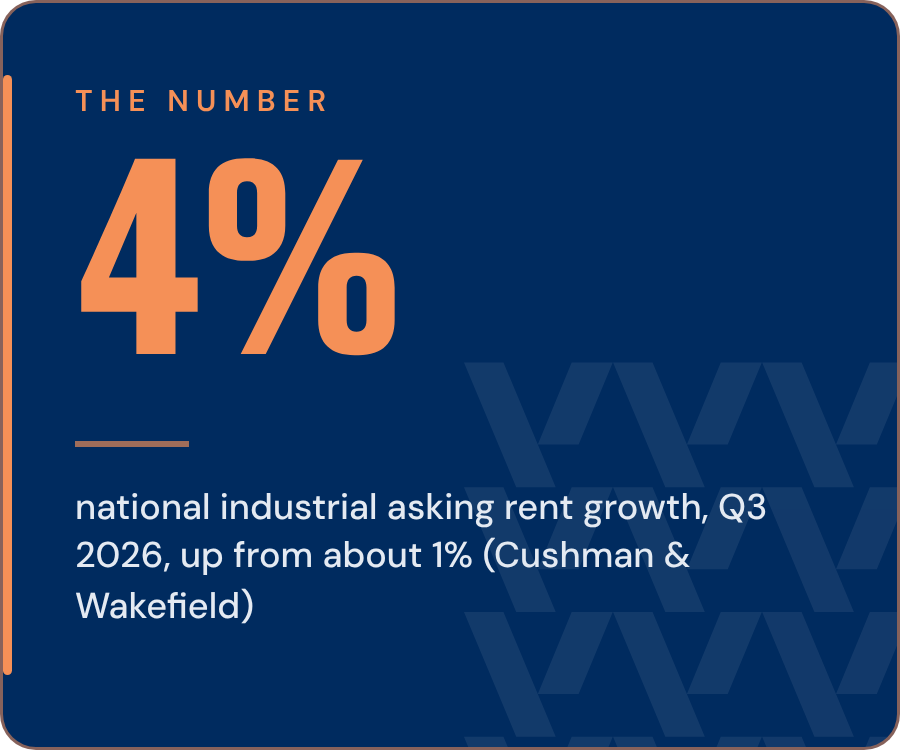
In its third quarter report, Cushman & Wakefield found that national asking rent growth for industrial space reached 4%, up from roughly 1% during the second half of 2025. It was the third straight quarter of acceleration.
Demand is doing the work. Net absorption, the measure of how much space tenants took on balance, reached 76.6 million square feet in the quarter, the highest since early 2023. National vacancy fell to 6.8%, down from a peak of 7% at the end of 2025. New construction stayed modest, with completions so far this year running 13% behind last year's pace.
And manufacturers are a big part of the story. According to the same report, manufacturing companies were the second most active type of tenant through the first three quarters of 2026, and accounted for more than a quarter of all leasing activity this year, up from about 23% in each of the three years before.
Newer Buildings Fill First
There is one more thing worth noticing in the report. The strongest demand has gone to newer buildings. Cushman & Wakefield found that availability in newer facilities is tightening and demand is now spilling over into older properties.
That is the pattern a manufacturer should pay attention to. The buildings that suit modern production, with real power, good clear height and room for automation, are the ones that go first. When the market tightens, the choice narrows to whatever is left.
The construction pipeline is growing again, but much of it is not aimed at a typical manufacturer. Build to suit projects make up about 35% of everything under construction, and more than 55% of the largest projects, as big logistics companies build custom facilities for themselves.
None of this means rents will rise everywhere at the same pace. Cushman & Wakefield found the strongest gains in parts of the South and Midwest, while rents kept softening in some coastal markets. But the national direction has turned, and a company planning a move in 2027 or 2028 should plan for a market that is firmer than the one it saw a year ago.
What That Means Here
In the Asheville area, the market was already tight before the national numbers turned. Industrial vacancy here is under 4%, compared with roughly 7% in Greenville and Spartanburg and about 9% in Charlotte.
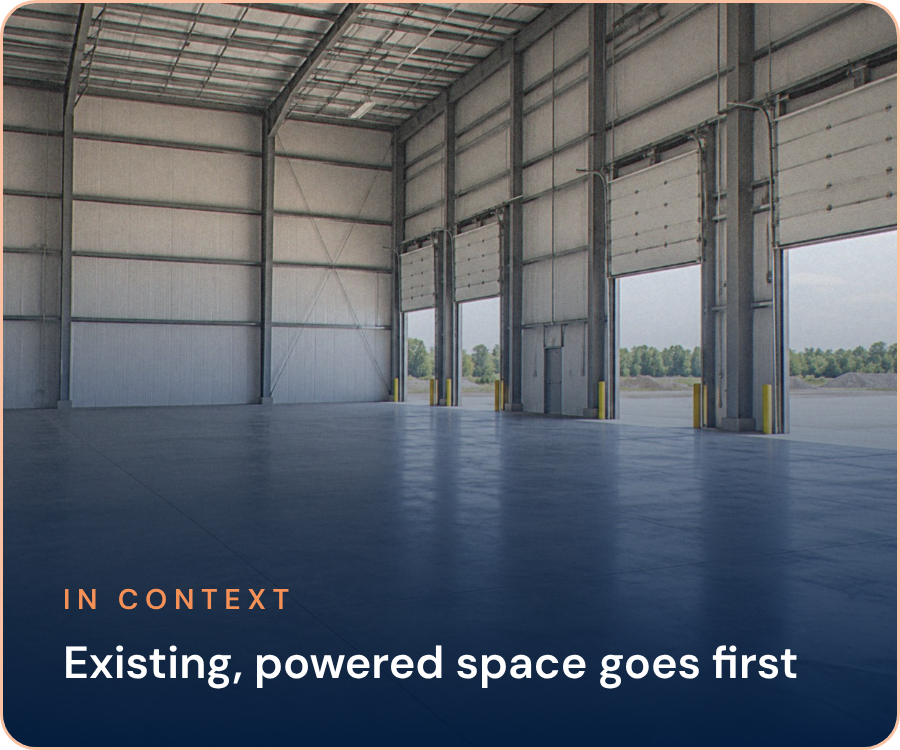
That is not a reason to think there is nothing available. It is a reason to understand that existing, powered space in this region is valuable, and that the good options do not sit on the market for long.
It also changes how a company should read national headlines. When a report says tenants have more choice, that is an average across dozens of markets, many of them full of new distribution space. A manufacturer that needs power, rail or clear height is shopping in a much smaller pool, and that pool behaves like a tight market even when the national average does not.
For a manufacturer, the practical point is timing. A lease decision made six months before a lease expires is a decision made under pressure. A decision made 18 to 24 months out is a choice.
Starting early also gives a company room to plan the move itself: equipment, power hookups, permits for any fit out, and the hiring that has to happen before the first shift. Every one of those steps is easier with a year of runway than with a quarter.
Rent Is Still the Wrong Number to Compare
Rising rents make it tempting to focus on the rent line. That would be a mistake. Rent is one line in what a plant costs. Power, labor, taxes, insurance and freight make up the rest, and freight especially is set by where you sit.
That is where Western North Carolina tends to win. North Carolina's corporate income tax is 2.0% in 2026, the lowest of the 44 states that levy one, and is scheduled to fall to 0% by 2030. The parks here sit on the I-26 corridor with direct I-40 access, about an hour from Inland Port Greer and its overnight rail to the Port of Charleston.
Vintara owns and operates three industrial parks just outside Asheville, in Fletcher and Arden, with about 800,000 square feet of manufacturing space. Two of the three parks are rail served, Quality Point offers 9MW of expandable power and SkyPoint offers 16,000 amps. Leasing an existing building typically puts a manufacturer into production in 6 to 12 months, instead of the 18 to 36 months it takes to build.
The building also comes with an owner that runs it. Our own construction crew and 24/7 facilities staff take care of the building, so a tenant does not need to hire a facilities team, and a problem on a Saturday night gets a call answered.
In a market that is tightening again, the right comparison is your full cost to operate, here and where you are today, made early enough that you still have options. For many manufacturers, that all-in number comes out up to 20% lower per square foot in Western North Carolina.
Get a free relocation snapshot comparing your all-in cost where you operate today with Western North Carolina. To walk through it with Scott, book a time.
