
Planning an upfit? See your all-in cost in Western North Carolina.
Get a free relocation snapshotOn October 15, 2026, the state's Rural Infrastructure Authority approved six Building Reuse grants. Two went to manufacturers moving into vacant buildings of 26,447 and 17,170 square feet. For a smaller manufacturer, the details matter more than the headline.
When people hear about state incentives, they picture the big announcements: a billion dollar campus, thousands of jobs, a governor with a shovel. Most manufacturers will never be that project.
The grants that fit a more typical company get less attention. North Carolina's most recent round shows what they look like.
On October 15, 2026, the state's Rural Infrastructure Authority approved nine grants for local governments. Six were under the Building Reuse Program, according to NC Commerce.
Two Vacant Buildings, Two Small Plants
Two of the six grants were in the vacant building category, and both went to manufacturers of the size most companies actually are.
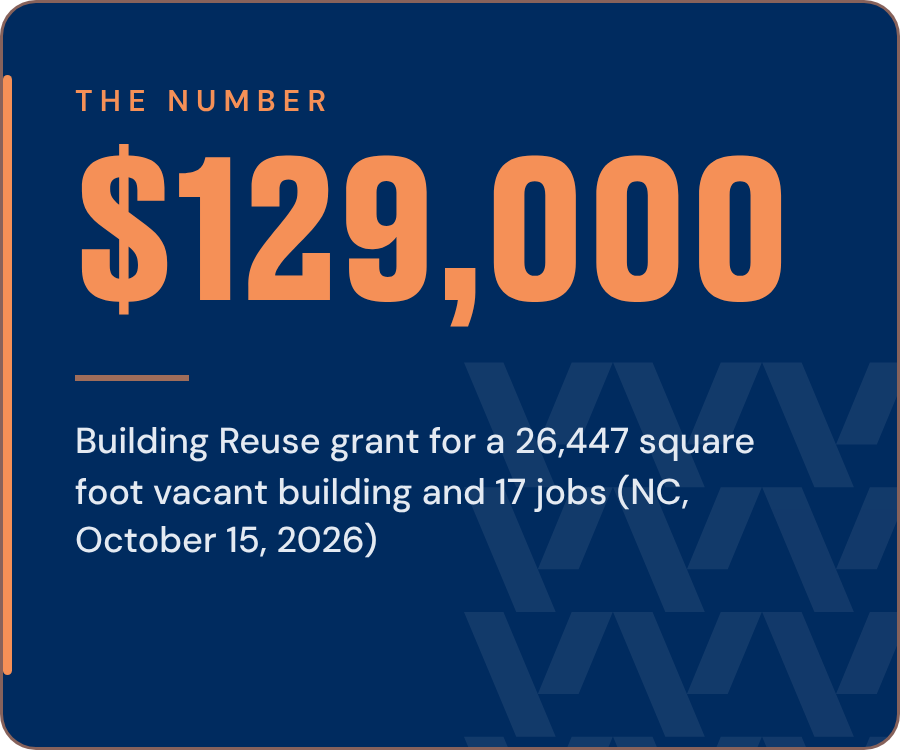
In Shelby, a $129,000 grant supports reuse of a 26,447 square foot building for Safety Test and Equipment Company, which makes safety equipment for utility workers and repair trucks. The project is expected to create 17 jobs.
In Fayetteville, a $152,000 grant supports reuse of a 17,170 square foot building for Sigma Crossings and Railroad Products, which makes products for short line railroads, transit systems and industrial customers. The project is expected to create 20 jobs.
Neither is a megaproject. Each is a manufacturer moving into an existing building, with a grant that helps pay to make the building work for them.
How the Program Works
The state's program page sets out the rules. A few matter most to a manufacturer planning a move:
The grant goes to the local government, which applies on the project's behalf.
The vacant building category covers renovation and upfit of buildings that have been vacant for at least three months before the application deadline: HVAC, electrical, plumbing, roofing and similar work inside the existing footprint.
The grant never exceeds half of the renovation cost, and the program requires a dollar for dollar cash match.
Awards depend on location, the number and quality of jobs committed and overall economic impact.
If the committed jobs are not created and kept for six consecutive months during the two year grant period, the grant must be repaid.
Eligible applicants are local governments in Tier 1 and Tier 2 counties, and in rural census tracts of Tier 3 counties. Buncombe and Henderson counties are Tier 2 for 2026.
Timing Is the Part Companies Miss
The Rural Infrastructure Authority meets six times a year to make awards. That rhythm matters. A company that signs a lease and starts its upfit before the local government has applied can find it has missed the window, or that its work no longer fits the program.
The practical sequence is to talk with the county's economic development office early, before the lease is final, so the application, the match and the renovation schedule line up. The incentive should be planned into the move, not discovered after it.
It is also worth knowing that North Carolina publishes new county tier rankings each year. A company planning a move into 2027 should check the current tier for the county it is considering before it builds an incentive into its numbers.
Why Existing Buildings Fit
Building Reuse funds work on existing buildings. A company building from the ground up cannot use the vacant building category at all. That is one more reason the existing building route favors smaller manufacturers: the program is designed around the kind of move they make.
Vintara owns and operates three industrial parks in Fletcher and Arden, in Henderson and Buncombe counties, with space from 10,000 to 300,000 square feet. Cummins and Tageos are both part of the Vintara family, plus a bunch of smaller shops. Our own construction crew handles upfits, which makes it easier to line a renovation schedule up with an incentive timeline. You can see the parks on our portfolio page.
Leasing an existing building typically puts a manufacturer into production in 6 to 12 months, compared with 18 to 36 months to build. An incentive planned in from the start can make that path less expensive as well as faster.
Get your free relocation snapshot, which compares your all-in cost where you operate today with Western North Carolina. To walk through it with Scott, book a time.
