
Planning a move? See your all-in cost in Western North Carolina.
Get a free relocation snapshotElectricians build, power up and keep a plant running. The federal government projects tens of thousands of openings a year, and manufacturers are competing for those crews with data centers and utilities. Here is what that means for a company planning a move.
Every plant runs on electricity, and every plant needs electricians to get it there. They pull the service into the building, wire the equipment, commission the controls and fix things at two in the morning when a line goes down.
Right now, those people are hard to find.
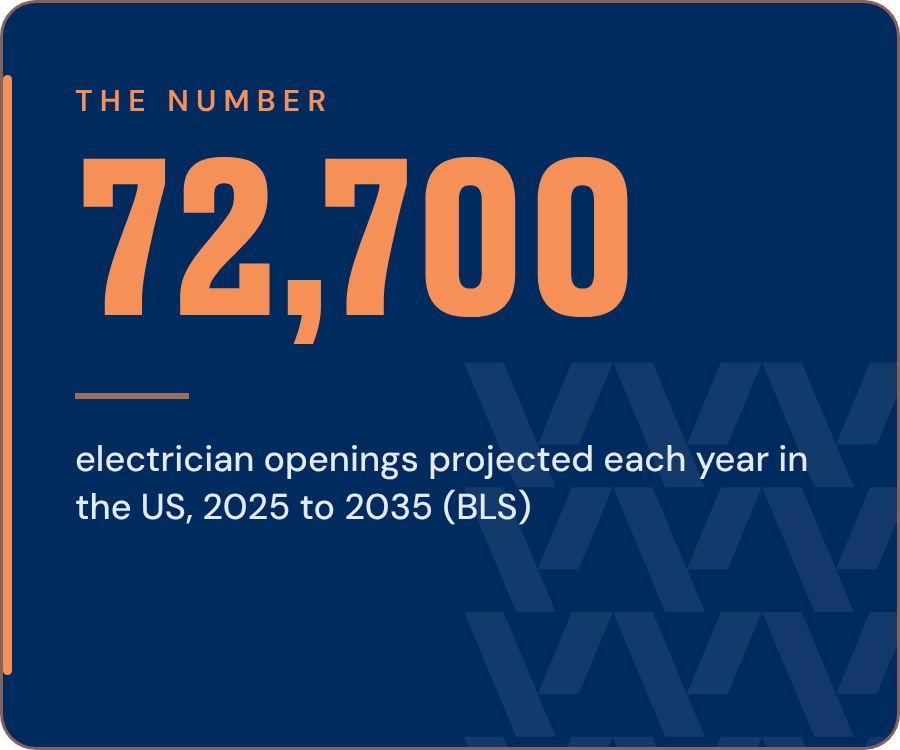
The U.S. Bureau of Labor Statistics counts about 821,000 electrician jobs in the country and projects employment to grow 9% from 2025 to 2035, much faster than the average for all occupations. It projects about 72,700 openings for electricians every year over that decade. Many of those openings come from workers who retire or leave the trade, not from new jobs.
Manufacturers Are Not the Only Ones Hiring
A manufacturer planning a move is competing for electricians with everyone else who is building. Data centers need them. Utilities need them. Every new plant announced in the Southeast needs them, during construction and long after.
North Carolina feels this directly. In June, the Governor's office noted that the average age of a licensed electrician in the state is in the upper 50s, and that unless young people enter the trade in far greater numbers, retirements will leave employers without the workforce they need. Blue Ridge Community College quoted that warning when it announced its own summer electrical program.
For a company moving a plant, the shortage shows up in two places. The first is the move itself. Building a new facility or heavily upgrading an old one means finding electrical contractors with open schedules, and in a busy market those schedules stretch. The second is every year after. Someone has to maintain the switchgear, the drives and the controls, and that person is on your payroll or on a service contract.
What Western North Carolina Is Doing About It
The region is not waiting. This summer, Blue Ridge Community College in Henderson County ran one of 12 Summer Electrical Academies in North Carolina, part of a statewide effort supported by the Siemens Foundation's $9.5M investment in the Careers Electric initiative. The network's stated goal is to increase enrollment in Electrical Systems Technology programs by 20% at each selected school over three years.
Students in the Blue Ridge academy learned wiring, electrical systems, safety practices and the National Electrical Code, earned industry certifications, and were pointed toward the college's apprenticeship program. In Buncombe County, A-B Tech's Electrical Systems Technology program trains students for installation and maintenance work in industrial and commercial settings.
None of this makes the shortage disappear next quarter. It does mean the region is building the pipeline a plant will draw from for years.
Take the Electrical Work Off Your Critical Path
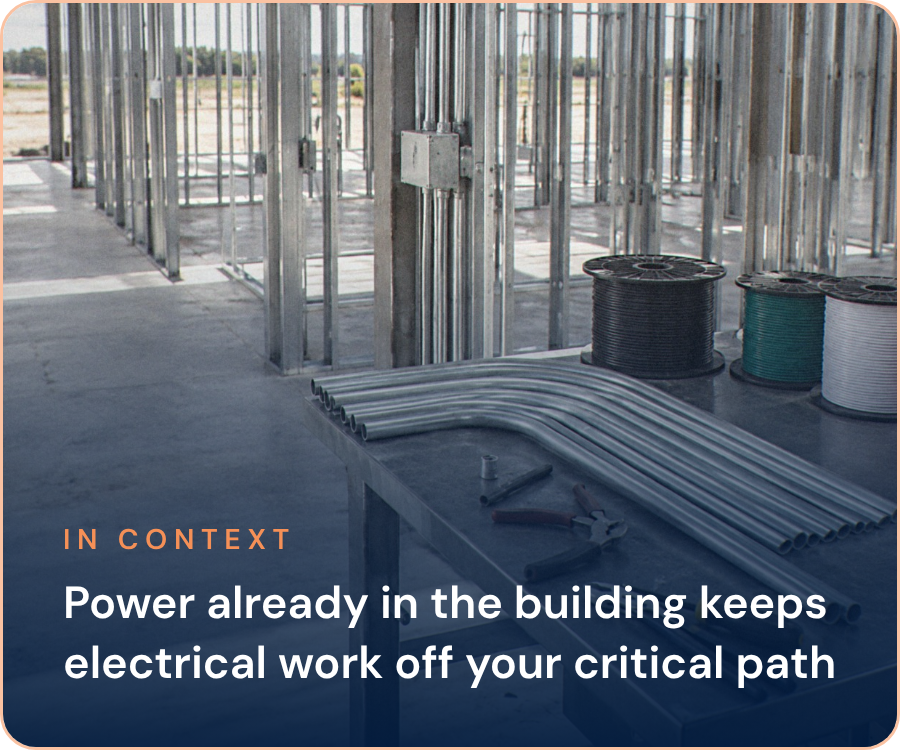
The most practical way to deal with a scarce trade is to need less of it at the worst possible time. A plant built from the ground up puts electrical work squarely on the critical path: service, distribution, every circuit and panel, all before the first machine runs. In a tight market, that is where schedules slip.
An existing building with the power already in place changes that. Our parks were built for manufacturing load. Quality Point has 9MW of expandable power and SkyPoint has 16,000 amps, which is why we wrote recently about power that is already there. A tenant still wires its own equipment, but it is not waiting on someone to bring adequate power to the site first.
After move in, the question is who keeps the building running. Vintara owns and operates its parks, with our own construction crew and 24/7 facilities staff. The building's electrical systems are our job, so a tenant's hiring can go where it counts, on the production floor.
Leasing an existing building typically puts a manufacturer into production in 6 to 12 months, compared with 18 to 36 months to build. In a market where electricians are booked out, much of that difference is the electrical work you do not have to wait for.
Questions to Ask Before You Choose a Site
Is the power my equipment needs already at the building, or does it have to be brought in?
How much electrical work stands between signing and the first production run?
Who maintains the building's electrical systems after I move in?
Which local colleges train electricians and maintenance technicians, and how many each year?
The answers tell you whether the electrician shortage is a footnote in your move or the thing that sets its schedule. You can see our parks and their power before you decide.
Get your free relocation snapshot, which compares your all-in cost where you operate today with Western North Carolina. To walk through it with Scott, book a time.
