
Before you commit to a new plant, see your all-in cost in an existing building here.
Get a free relocation snapshotCensus data released November 2, 2026 show US manufacturing construction spending down 17.0% from a year earlier, while most manufacturers in this year's reshoring survey say they plan to invest in US capacity. The difference between those two numbers is where existing buildings matter.
For years, bringing manufacturing home was framed as a question of will. Would companies commit? Would boards accept higher costs for shorter supply chains?
That narrative is outdated. The will is there. The new buildings are not.
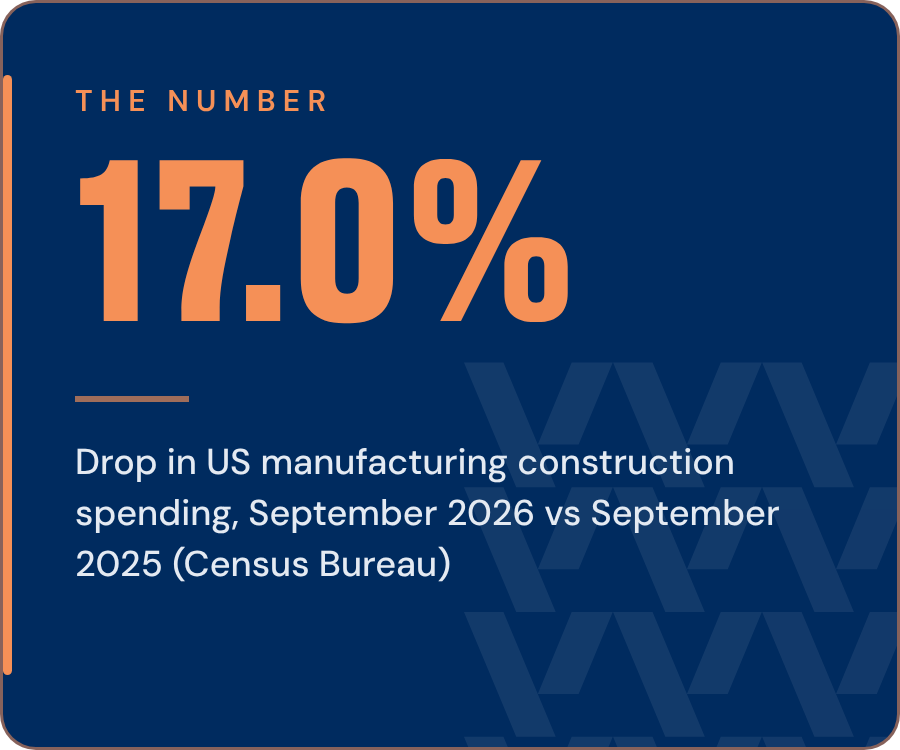
On November 2, 2026, the Census Bureau reported that spending on manufacturing construction in the United States ran at a seasonally adjusted annual rate of $170.2 billion in September 2026. A year earlier it was $205.0 billion. That is a drop of 17.0% in twelve months, in the middle of what is supposed to be a reshoring decade.
The Plans Have Not Gone Away
The intent to produce in the United States is still strong. In the 2026 USA Reshoring Survey, conducted by the Reshoring Initiative and Regions Recruiting with 249 manufacturers responding, 63% of the original equipment manufacturers surveyed said they would be making US capital investments to support reshoring or other domestic expansion. More of them reported having reshored, or being actively engaged in it, than a year earlier.
The same survey shows a quieter change that matters even more. Among those OEMs, 40% now use total cost of ownership to compare offshore and domestic options, up from 30% in 2025. That is the right way to make the decision. Reshoring is a question of total cost, not patriotism, and more companies are treating it that way.
Why the Shovels Have Slowed
If the plans are there, why is construction falling? The survey offers the clearest answer. Among the OEMs, 57% named policy uncertainty, such as tariffs changing with little notice, as their primary challenge. Nothing else came close.
Uncertainty does not kill a reshoring plan. It changes the kind of commitment a company is willing to make. A new plant is an 18 to 36 month bet that the economics will still hold when the doors open. Many owners and CFOs are reluctant to place that bet when the rules can change in a quarter.
Whatever the mix of reasons behind the decline, the effect for a midsize manufacturer is the same. Fewer new industrial buildings are going up, and the decision to build one has become harder to justify.
Existing Buildings Close the Gap
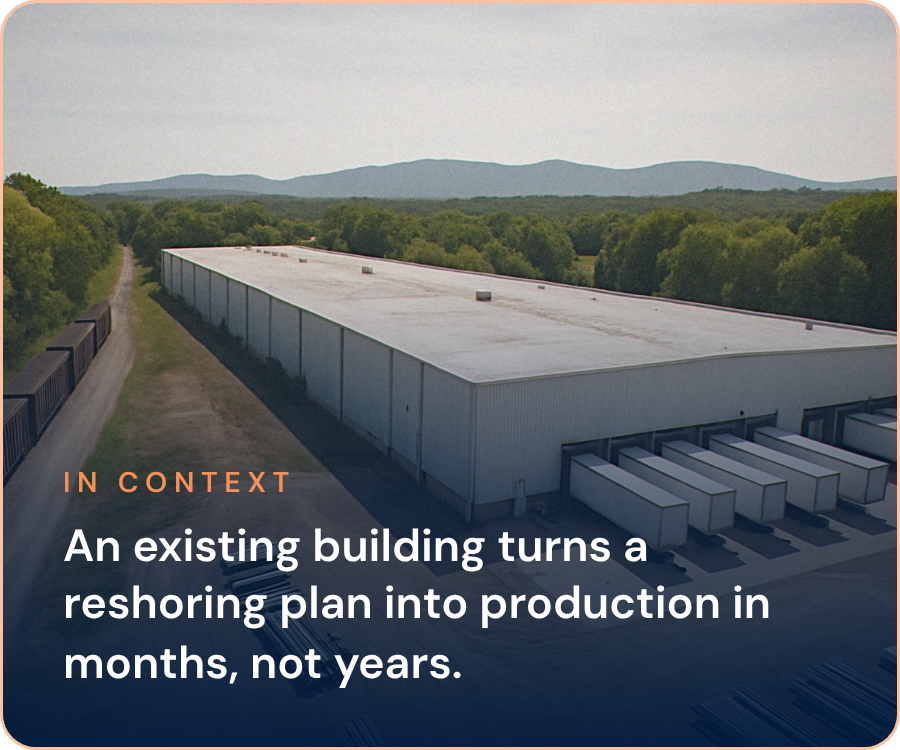
There is a way to act on the plan without making the 36 month bet. An existing industrial building can put a company into production in 6 to 12 months instead of the 18 to 36 months a build takes. That shorter horizon matches the planning window most companies can see clearly today.
It also changes the risk. A lease keeps capital in the business instead of in concrete and steel, and it leaves room to adjust if trade policy shifts again. A company can prove out a US line, learn its local labor market and grow into a larger footprint without committing to a site it cannot easily leave.
What a Reshoring Move Needs From a Building
Not every empty building can absorb a production line that used to run overseas. The ones that can tend to share a few traits, and they are worth checking before anything else.
Power that matches the equipment list, with room to expand as the line grows.
Clear height for racking, overhead cranes and future automation.
Freight access for both inbound materials and outbound product, by truck and, ideally, by rail.
A labor market with the specific skills the line needs, and a training partner that can fill the gaps.
Freight deserves special attention, because location sets it and no lease negotiation fixes it later. A plant that imports components and ships finished goods across the country needs a short path to a port and to an interstate. In Western North Carolina, that path runs about an hour to Inland Port Greer, with overnight rail to the Port of Charleston, and directly onto I-26 and I-40.
Workforce matters just as much. A reshored line usually depends on machinists, maintenance technicians and automation specialists. The region's industrial base and customized training through A-B Tech and NCEdge give a company moving here a way to build that team, rather than hoping it already exists.
In Western North Carolina, that kind of space is scarce. Industrial vacancy around Asheville is under 4%, which is exactly why existing buildings with real power, rail and clear height are valuable. Manufacturers already here, including Cummins and Tageos, are about an hour from Inland Port Greer, with overnight rail to the Port of Charleston.
Vintara owns and operates three industrial parks in Fletcher and Arden, with buildings that are already powered and two parks served by rail. Our own crew handles the building, so a tenant can spend its first year on production rather than on construction.
The Decision in Front of Most Manufacturers
The choice for most companies is no longer whether to produce more in the United States. It is how to do it while the rules keep moving.
That calls for a plan built around total cost and time, not around a ribbon cutting. Run the numbers on what the line will cost to operate in each location, including power, labor, taxes and freight, then ask how long each option takes to reach first shipment.
The answer for many will not be a new plant. It will be a building that already exists, in a place where the total cost works, leased on a timeline the business can actually plan around.
The plans are rising. The plants will follow. The question is whose building they move into.
Get a free relocation snapshot comparing your all-in cost where you operate today with Western North Carolina. To walk through it with Scott, book a time.
