
See what your energy and operating costs could look like here.
Get a free relocation snapshotFederal data show electricity is the largest share of what US manufacturers spend on purchased energy, and that well under half of plants were working actively on energy management. Some of that bill belongs to the process. A surprising amount belongs to the building.
Ask a plant manager where the electricity goes and the answer is usually the machines. Ovens, compressors, presses, chillers on the line. That is where the attention goes, too.
The building gets less attention. It should get more.
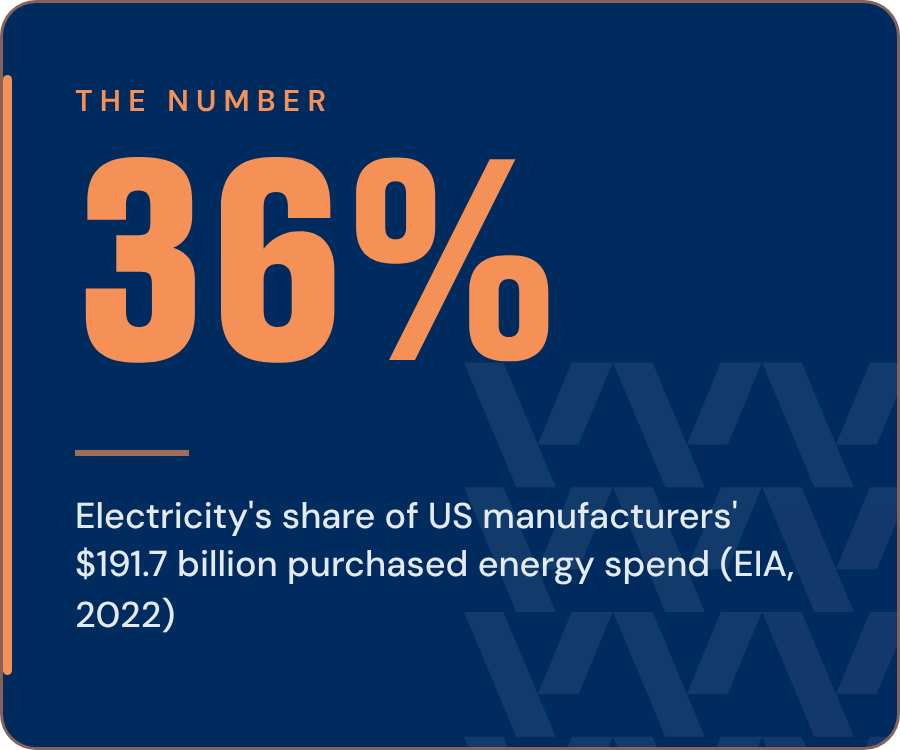
In its most recent Manufacturing Energy Consumption Survey, covering 2022, the U.S. Energy Information Administration found that US manufacturers spent $191.7 billion on purchased energy. Electricity was the largest single piece, at 36% of that spend, ahead of natural gas at 26%.
Where the Building Shows Up on the Bill
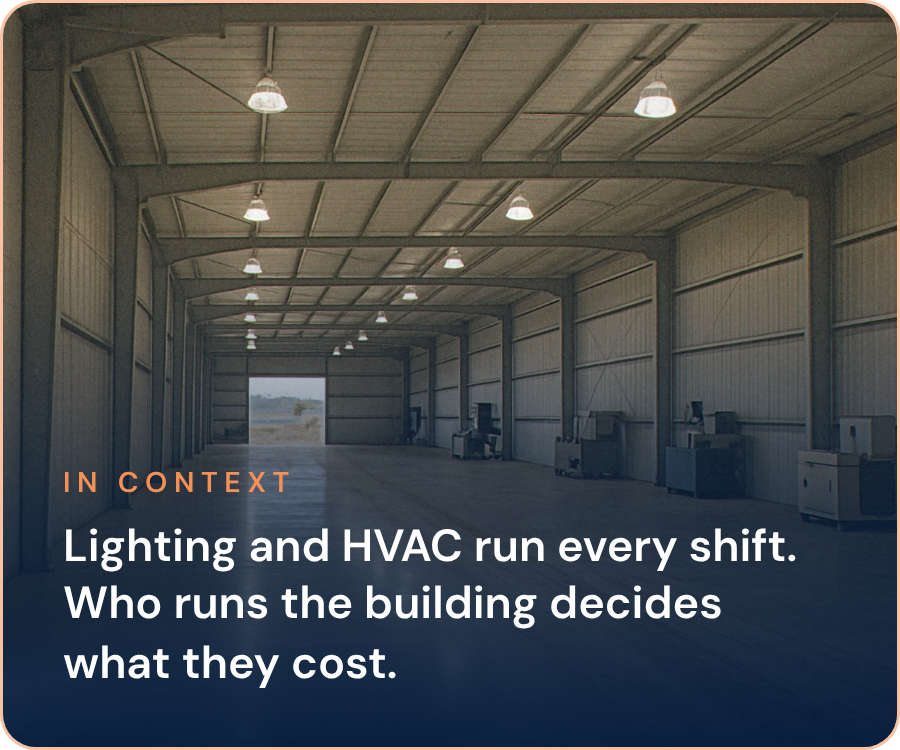
Much of a plant's electricity goes to the process, and that is the tenant's business. But a meaningful share goes to things the building controls. EIA lists facility lighting and heating, ventilation and air conditioning among the main nonprocess uses of energy in manufacturing. Those systems run every shift, whether the line is full or not.
They are also where most of the improvement has happened. In the same 2022 survey, 42% of manufacturing establishments took part in general energy management activities. Lighting renovations were the most common, at 47,083 establishments, followed closely by HVAC improvements.
Read that the other way and the opportunity is clear. More than half of US manufacturing establishments were not doing general energy management at all. For a company that leases its building, much of that work is not even in its hands. It depends on who owns and runs the building.
An Owner That Runs Its Buildings Changes the Math
In a typical lease, the landlord owns the roof, the air handlers and the lighting, and the tenant pays the bill those systems produce. When the owner is a distant investor, there is little reason to spend money on systems that mostly lower someone else's costs. The tenant pays for that indifference every month.
An owner that also operates its buildings sees it differently. Lower operating costs keep tenants, and a building that runs well is easier to lease. So the investment gets made.
Quality Point, Vintara's flagship park in Fletcher, is the working example. Over a series of upgrades, the building received a cloud building management system, variable frequency drives on 12 air handlers, more than 300 LED fixtures, a chiller sized to the load and a reflective TPO roof across more than 270,000 square feet.
Across Vintara's parks, that work shows up on tenants' bills. We projected our tenants would save $50,000 on electricity in 2026. Through October, they have saved $68,000, about 17% of their electricity cost, or roughly 20 cents per square foot a year. Tenants are submetered, so each company sees its own use rather than an allocated share of someone else's.
Vintara's Class A facilities run full building management and building intelligence systems that track energy use across each building and use AI to analyze consumption patterns and predict savings, keeping that line of the bill as low as possible for manufacturing tenants.
Measured, Not Allocated
Submetering sounds like an accounting detail. It is one of the most important things a manufacturer can ask about.
In a building without it, the utility bill is divided among tenants by square footage or some other formula. A company that runs efficient equipment and tight shifts pays for the neighbor that leaves the compressors running all weekend. The tenant has no way to see the waste, and no reason to fix its own.
With submetering, every tenant pays for what it uses. That makes the energy line predictable for a CFO and gives a plant manager a number to manage. It also means the savings from the building's upgrades show up on the tenant's own bill, where they belong.
The same logic applies to maintenance. A failed air handler or a dark section of the plant floor costs production time, not just repair money. Vintara's own construction crew and 24/7 facilities staff exist so that a tenant does not need to hire its own facilities team to keep the building running.
What to Ask a Landlord About Energy
When a manufacturer compares sites, the conversation usually stops at rent and the utility rate. A few more questions tell you far more about what you will actually pay.
Is the space submetered, or will your bill be an allocation?
When were the lighting, HVAC controls and roof last upgraded, and who paid for it?
Who runs the building day to day, and how fast do they respond when something fails?
Has the owner used the local utility's incentive programs, or left that money on the table?
The answers separate a building that writes a lower bill every month from one that simply passes the bill along.
None of this replaces the work a manufacturer does on its own process. Efficient equipment and good scheduling still matter most. But the building is the one part of the energy bill a tenant often cannot fix alone, which makes the choice of building, and of the company that runs it, an energy decision in its own right.
The Bill Is Part of the All-In Cost
Rent is one line in what a plant costs. Power, labor, taxes, insurance and freight are the rest of it, and the energy line depends as much on how the building is run as on the rate the utility charges.
That is why the right comparison between two sites is never rent against rent. It is everything the building will cost to run, year after year. In Western North Carolina, with an owner that runs its buildings and has already done the energy work, that number can be up to 20% lower per square foot than where many manufacturers operate today.
Get a free relocation snapshot comparing your all-in cost where you operate today with Western North Carolina. To walk through it with Scott, book a time.
