
Planning to automate? See your all-in cost in Western North Carolina.
Get a free relocation snapshotNorth American companies ordered nearly 11,000 robots in the third quarter, and the growth came from semiconductors, electronics and life sciences as much as from car plants. Every one of those robots needs power delivered where it sits.
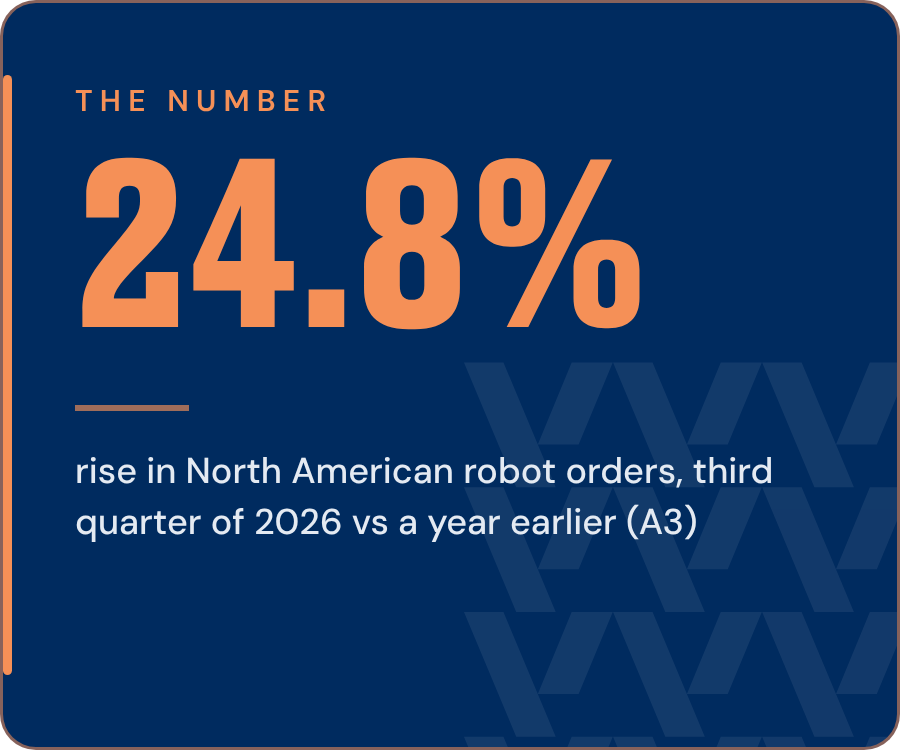
North American companies ordered 10,989 robots in the third quarter of 2026, valued at $723.5M, according to the Association for Advancing Automation (A3). That is 24.8% more units than a year earlier, and the strongest quarter of the year so far. Through September, orders reached 28,984 robots worth about $1.89B.
The growth was not limited to car plants. Orders from semiconductor and electronics makers nearly doubled, up 97.6% in units. Life sciences and pharmaceutical orders rose 38.7%. Plastics and rubber rose 67.7%, and metals 37.0%. Collaborative robots, the smaller arms built to work alongside people, rose about 56%.
A3 also pointed to the backdrop: the September ISM Manufacturing PMI registered 54.5, a ninth straight month of expansion. Companies are not just talking about automation. They are buying it.
Those are many of the same industries bringing production back to the US. And every one of those robots has to plug into something.
For a manufacturer comparing locations, that changes the checklist. The question is no longer only what a building costs today. It is whether the building can carry the plant you expect to be running three years from now.
Automation Changes What a Building Has to Do
A robot cell is not just a machine on the floor. It needs power delivered where it sits, room around it for guarding and material flow, and a building that can carry more load as more cells come online.
Most companies do not automate all at once. They add a cell, then another, then a line. A3's numbers show how that spreads: through September, collaborative robots made up 43.8% of robot orders in life sciences and 36.9% in semiconductors and electronics. Smaller robots spread across more of the floor mean more power drops, in more places, over time. The building has to keep up.
That is where an underpowered building becomes a problem. If the service is already near its limit, more automation means a utility upgrade, and an upgrade means new electrical equipment and a place in line. Wood Mackenzie reported switchgear taking about 44 weeks on average from order to delivery in 2025, and power transformers about 128 weeks.
The cost of that wait is not just the equipment. It is robots sitting in crates, a line that does not run and orders that go somewhere else.
Automation also raises the cost of an outage. When a line runs on robots, a power problem does not slow the work down. It stops it. That puts the quality of the building's electrical service, and the speed of whoever maintains it, on the critical path.
Plan the Building Around the Power
For a company planning to automate, power belongs at the top of the site checklist, next to rent and labor. A few questions worth asking about any building:
How much power is available at the building today, and how much more can be added without a new utility service?
Can power be run across the floor as cells are added, or does every new machine mean new wiring through the walls?
Do the clear height and floor work for the equipment around the robots, not just the robots?
Who handles the electrical work when you add the next cell, and how fast can it be done?
None of those questions are about the robots. They are about the building, and they are far easier to answer before you sign a lease than after the equipment arrives.
Robots Still Need People
Automation does not replace skilled people. It raises the value of the ones who can install, program and maintain the equipment. The U.S. Bureau of Labor Statistics projects employment of industrial machinery mechanics, machinery maintenance workers and millwrights to grow 14% from 2025 to 2035, much faster than the average for all occupations, with about 51,900 openings a year.
Western North Carolina has a long history of precision, equipment intensive manufacturing and a training pipeline built around it, including customized training through A-B Tech. We wrote about the region's newest training investment in A Factory for Skilled Workers.
That cuts both ways. The people who keep robots running are the same people every other plant is trying to hire. A building that someone else maintains lets them spend their hours on the line, where the automation pays for itself.
What We Have Ready
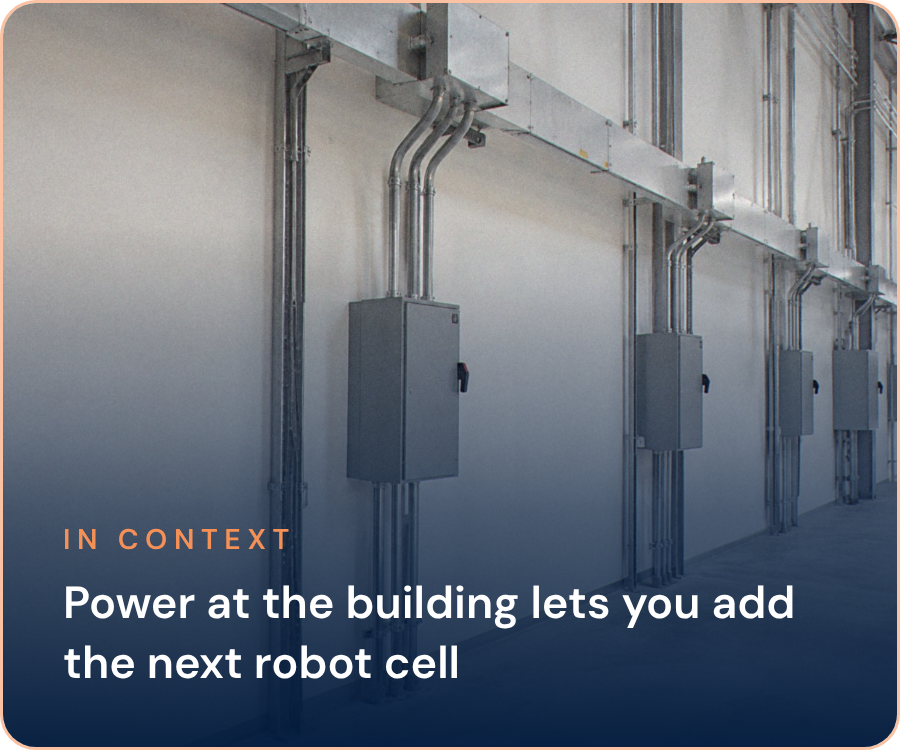
Vintara owns and operates industrial parks just outside Asheville with power already in place: 9MW at Quality Point today, expandable to 13MW, and 16,000 amps at SkyPoint Industrial Park, with flexible configurations. Our buildings offer 25 feet of clear height. Our own construction team controls cost and schedule when a tenant adds equipment, and our 24/7 facilities staff keep the building running.
Rail serves AC Industrial Park and SkyPoint, and our parks sit directly on the I-26 corridor, about an hour from Inland Port Greer, so parts coming in and product going out move as easily as the power does.
Existing powered buildings can have you producing in 6 to 12 months instead of the 18 to 36 months a new build takes. That matters more when the equipment you are installing is already on order.
Start With Your Own Numbers
Robots change the math on labor, but power, freight, taxes and rent still decide what a plant costs to run. Get your free relocation snapshot, which compares your all-in cost where you operate today with Western North Carolina. To walk through it with Scott, book a time.
